Evidence note: This comparison uses current official product, pricing, support, compliance, retention, export, and partner records. ServiceTech Signal has an active CallRail affiliate relationship and an Aircall application awaiting approval. Neither product has completed the same direct scenario, so the decision remains conditional and no numerical winner is assigned.
What changed on 14 November 2026
Evaluate CallRail first when the question is which marketing source produced a qualified enquiry and the team can govern tracking numbers, attribution and downstream reconciliation. Evaluate Aircall first when the bottleneck is a shared team phone system with owned queues, routing and call follow-up. Use both only when the two distinct jobs justify the configured cost and a tested handoff. Neither replaces CRM/FSM, scheduling, dispatch, estimates, invoices, payments or the technician record.
Dated method: Primary pricing, API, legal and support sources reviewed on 14 November 2026. Both sides remain Desk evidence; neither has completed the same direct ServiceTech Signal account scenario. Vendor documentation describes capability, not our call quality, attribution accuracy, recovered handoff, compliance or customer outcomes. The original decision table, evidence ledger, cost controls, unresolved questions and sources remain below. Proposed buyer checks are not completed hands-on tests.
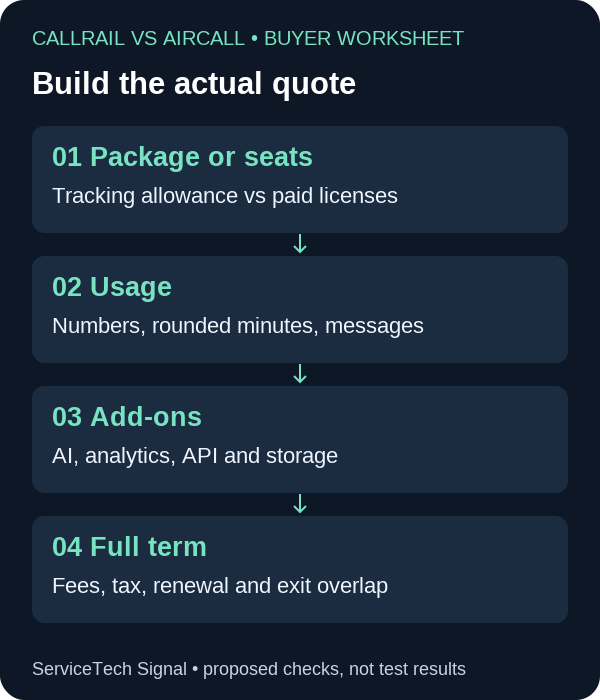
Normalize configured cost, not two headline prices
The CallRail US pricing surface, with Yearly selected on 5 November, showed Lead Tracking USD50, Lead Tracking Complete USD95, Lead Conversion USD150 and Lead Conversion Complete USD195 per month plus usage. Each starts with five local numbers and 250 local minutes; the comparison lists 25 SMS after trial. Annual base fees are prepaid for 12 months; usage is billed separately and call minutes round up per call. Confirm market, tax, renewal and purchase screen rather than treating this as a universal quote.
The Aircall US annual selector showed Essentials USD30 and Professional USD50 per license/month, each with three users minimum. Hypothetical three-license base arithmetic is 3 x 30 = USD90 or 3 x 50 = USD150 per month equivalent, before other charges. This seat model is not equivalent to CallRail's number/minute package. Country, number type, domestic/international calling, messages, AI, analytics and integration scope remain quote controls.
| Control | CallRail | Aircall |
|---|---|---|
| Base and users | Exact tracking/conversion plan, companies, staff permissions and term. Never count a tracking number as a staff license. | Required plan, paid users, minimum bundle, annual/monthly commitment and renewal. Written peak-season staffing cost. |
| Numbers and calls | US pricing tables list extra local and toll-free numbers at USD3 and USD5 per month. The table with transcription included in local minutes lists USD0.06 per additional local minute and USD0.09 per toll-free minute. Tables that price transcription separately list USD0.05 and USD0.08, respectively. Confirm which table applies, rounding, transcription and carrier fees in your quote. | Table lists one included local/toll-free number and USD6/month per extra number. Confirm eligible country, inbound/toll-free/international rates and domestic-use conditions. |
| Messages and compliance | SMS table lists USD0.03 additional usage; confirm segments, registration, opt-in, carrier fees and all campaign costs. | Confirm SMS/MMS countries, domestic restrictions, registrations, segments, carrier fees and exact rates; do not infer free messages from a phone license. |
| AI, analytics and API | Separate conversation analysis, transcript export eligibility, Voice Assist and usage. Pricing FAQ lists API tiers: up to 1,500 calls/month free, 1,501-12,000 USD80/month, 12,001-300,000 USD200/month; verify higher needs. | Normalize AI Voice Agent minutes, AI Assist, Analytics+, integration plan, API scope, limits and overages. A feature label is not unlimited usage. |
| Implementation and exit | Add website/DNI work, CRM/FSM integration, migration, training, monitoring, storage/export, porting, taxes and cancellation overlap. Price normal and peak volume. Stop if a required line has no written rate, allowance, owner or renewal condition. | |
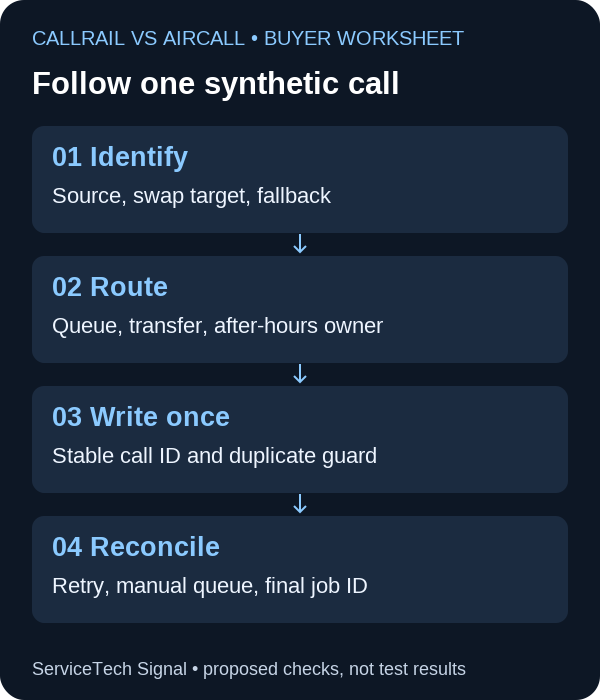
Own DNI, routing and the CRM/FSM handoff
CallRail API documentation describes dynamic number insertion: JavaScript finds a swap target and displays the tracking number appropriate to the visitor's source. A session pool, source tracker and destination number are different objects. Proposed checks: consent denied/allowed, script blocked, mobile tap-to-call, cached pages, repeat visitors, pool exhaustion and the original-number fallback. Stop if the visible number, dial target and destination disagree, or attribution is silently invented when source is unknown.
For the same fictional call set, map IVR, queue, transfer, overflow, voicemail and after-hours behavior to an on-duty human. Aircall's current plan surface distinguishes basic flows from Professional smart routing and callback. Require an approved escalation path before an AI or routing rule can create a callback, booking or external action. Neither a routing diagram nor vendor AI copy proves delivery, correct qualification or consent compliance.
Give every synthetic call a provider call ID, source/session ID where available, contact match, owner and CRM/FSM correlation key. Check missed, qualified, spam, duplicate, transferred and after-hours outcomes. Simulate a delayed or failed webhook, timeout and duplicate delivery only in the buyer's controlled pilot. Retry idempotently with the same event key; quarantine unmatched or conflicting records and alert a named owner. Stop automatic task/job creation if the same call can create two opportunities or if a transfer loses its owner.
Reconcile source to call, qualified enquiry, opportunity, job, invoice and payment using actual object IDs and agreed definitions. A call marked answered, an AI summary or a connected integration badge is not revenue. Use a manual reconciliation queue until all final objects agree. No new tenant, customer, accounting or payment tests were run for this article.
Recording consent, retention and dashboard visibility are separate gates
CallRail's March 2026 service description says recording and transcription are enabled by default for new service, can be disabled, and require customer-managed notice to participants, including third-party processing. Its recording page describes a customizable greeting and says external transcript export requires Premium Conversation Intelligence. A switch or greeting is not legal approval: the buyer must verify jurisdictions, staff notice, sensitive-data handling, opt-out, recording pause and deletion authority before use.
The CallRail API retention statement says Communication Records are retained for 25 months then automatically deleted; requests outside the window fail, including all_time requests. That is a retention boundary, not a complete archive, guaranteed access after cancellation or restore proof.
Aircall Privacy FAQs, modified 16 September 2026, distinguish plan-based recording retention from what is visible in the dashboard and limit storage after termination to up to 30 days. Do not describe a six-month dashboard as the complete retention period or an unlimited label as perpetual storage. Confirm the actual plan, retention instruction and export cutoff in writing.
Official-source scope warning: Aircall's data/export guide directs customers to support for call data older than six months and notes a separate Analytics+ download option. Its historical analytics guide separately permits Professional/Custom Call History exports up to 12 months, selecting at most six months per query, and gives Analytics+ join/subscription-date conditions. Obtain one written plan-specific answer rather than silently merging these surfaces. Neither promises every recording, activity or restorable configuration.
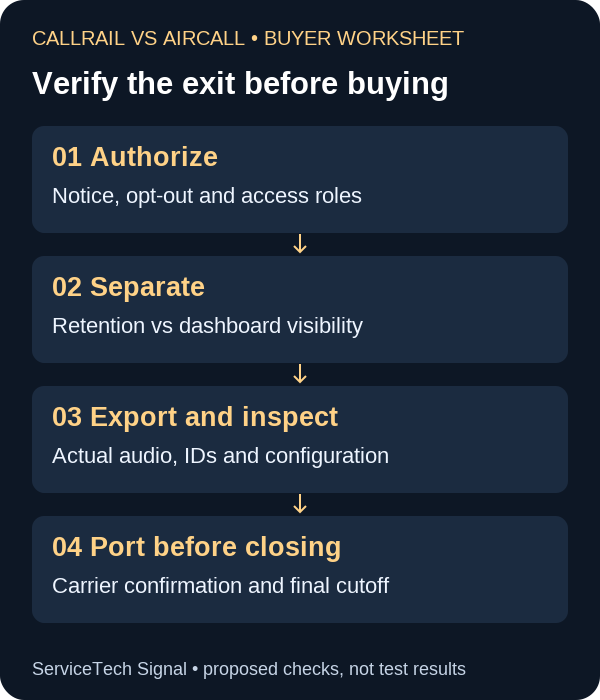
Portability, component exports and cancellation need an ordered exit
CallRail's phone-number guidance covers local/toll-free purchase and port-in. Its terms note possible port-in/out fees and charges through the current subscription term, with refund conditions subject to law. Require the gaining carrier to confirm each number's country/type eligibility, ownership documents, port-out procedure, fees and dates before cancellation. No generic port-out timetable or guaranteed portability is assumed here.
Aircall port-out guidance says the account must remain active until completion; a port does not automatically cancel the subscription. Some operator/range/service restrictions apply. Preserve exports and routing evidence before any number deletion, then confirm carrier completion and billing closure. A port moves a number, not call history, recordings, consent records, tags or configuration.
| Component | Required proof and stop rule |
|---|---|
| Call and attribution data | Call IDs, source/session and number maps, tags, notes, dispositions, durations, timestamps/timezones and contact associations. Reconcile filters, date windows, permissions and pagination. |
| Recordings and transcripts | Download actual files with a lawful retention basis; verify file bytes, playback, transcript eligibility, links and expiry. A CSV containing a URL is not possession of the audio. |
| Routing and consent | IVR, greetings, queues, hours, fallback, roles, number inventory, consent/opt-out evidence, AI rules and integrations. Record settings that must be recreated. |
| CRM/FSM and restore | Calls, tasks, contacts, jobs, email/history and attachments need separate component coverage. Reimport a synthetic sample, check counts and relationships, and document missing fields plus rollback. |
| Deletion and end date | Aircall's export guide says deleted recordings cannot be restored and may remove linked transcripts/AI insights; it describes a 30-day post-termination export window with legal-retention exceptions. Confirm deletion authority, number dependencies, cancellation notice, renewal, retrieval cutoff and final invoice before irreversible actions. |
What is call tracking?
YouTube connects only after you choose to load this video.
Run one synthetic call set, then keep, switch, use both or wait
Proposed buyer checks, not completed tests: Name a marketing owner, phone/queue owner, privacy owner, CRM/FSM integration owner and exit owner. With approved synthetic data and no real customer calls, replay the same missed, qualified, spam, duplicate, transferred and after-hours scenarios. Normalize configured cost; inspect DNI/fallback; check notice/recording; verify queue and human escalation; reconcile retried handoffs by stable IDs; export every required component and rehearse retrieval/rollback before cancellation.
- Keep the existing setup when required source, call handling and final-record controls already work and the cost is owned.
- Switch only when a specific unmet attribution or phone-workflow requirement passes the same protocol and number/data exit is written.
- Use both when both distinct problems exist, one number/route topology is documented and duplicate costs, recording policies and handoff owners are reconciled.
- Do not buy yet when country/number eligibility, recording authority, cost, retry/duplicate safety, export or post-termination retrieval remains unresolved.
Use the separate CallRail review and Aircall review for product evidence, the CallRail workflow protocol for a deeper pilot, and the cost calculator for normalized inputs. Keep this page's exact attribution-versus-team-phone decision separate from those owners. Read the pilot guide, switching guide, methodology, evidence boundaries and pilot scorecard before treating vendor claims as outcomes.
Direct answer
Which one should you choose?
CallRail is the stronger first evaluation for marketing attribution. Aircall is the stronger first evaluation for multi-user phone operations. Neither replaces scheduling, dispatch, estimates, invoices, payments, or technician records, and neither should be bought until the same synthetic lead is reconciled through the actual CRM or field-service system.
Marketing-led teams that need dynamic number insertion, campaign and visitor attribution, call and form tracking, lead-quality analysis, and source-to-revenue reconciliation.
Teams with at least three phone users that need shared numbers, IVR, routing, transfers, availability, queue controls, mobile calling, CRM logging, and agent analytics.
Evidence boundary: Both sides currently rely on official desk evidence for this comparison. ServiceTech Signal has an approved CallRail affiliate relationship and an Aircall application awaiting approval. No shared direct account scenario or numerical winner is published.
Evaluation options: Each link is identified as an official or partner path. A marked partner link may earn ServiceTech Signal a commission. Commercial relationships cannot change the evidence, caveats, or decision criteria.
The decision in one table
| Decision factor | CallRail | Aircall | How to decide |
|---|---|---|---|
| Primary job | Attribute calls, texts, and forms to marketing sources and evaluate lead quality | Run shared business calling and messaging across sales or support teams | Start with the unresolved business question: acquisition source or call handling |
| Website tracking | Company-specific DNI script, source numbers, website pools, cookies, and page-by-page swap tests | Not positioned as a visitor-level dynamic-number-insertion attribution layer | Choose CallRail when campaign and visitor attribution is required |
| Team phone operations | Call flows, routing, recordings, messaging, and lead-management controls support the tracking layer | Shared numbers, IVR, business hours, routing, warm transfer, queue callback, availability, mobile apps, and simultaneous calling | Choose Aircall when office and agent workflow is the core problem |
| Published annual entry signal | US Lead Tracking displayed from USD 50 monthly plus usage | US Essentials displayed at USD 30 per license monthly with a three-license minimum, or USD 90 monthly, billed annually | Compare the configured account, users, numbers, countries, usage, and add-ons rather than unlike headlines |
| Usage and add-ons | Numbers, rounded minutes, toll-free use, SMS, forms, transcription, analysis, Voice Assist, API use, and compliance can expand cost | Licenses, extra numbers, international calls, messaging, AI Voice Agents, WhatsApp, Analytics+, and other add-ons can expand cost | Model a peak month and the required retention and reporting window |
| SMS boundary | US business texting requires 10DLC registration and documented consent; the in-app flow has country and number-type limits | Domestic SMS is documented for selected countries and eligible number types; registration, carrier, rate, and local-law requirements still apply | Verify the exact number, country pair, consent flow, opt-out handling, and price |
| Recording and data | Recording and transcription require legal, notice, access, retention, deletion, and export controls | Recording access and analytics history vary by plan; broader or scheduled analytics exports can require Analytics+ | Write the retention, export, deletion, and incident requirements before production calls |
| Field-service boundary | Does not own jobs, schedules, estimates, invoices, payments, or technician completion | Does not own jobs, schedules, estimates, invoices, payments, or technician completion | Declare the CRM or FSM system of record and an idempotent handoff |
Commercial disclosure: A marked partner link may earn ServiceTech Signal a commission. Official vendor links without an affiliate relationship are identified separately. Commercial relationships cannot change our evidence, caveats, or decision criteria.
The lighter path fits the actual operation.
- Paid search, directories, landing pages, or offline campaigns generate enough call volume to justify source-level measurement.
- The team can reconcile caller, qualified lead, booked job, collected revenue, and disputed attribution in a governed system of record.
- Every relevant page can support and be tested for DNI, swap precedence, cache, iframe, click-to-call, and fallback behavior.
- Peak usage, consent, recording, messaging, export, and number-portability controls fit the written plan.
The additional capability has a current owner and return.
- At least three users need a shared phone workflow with routing, transfers, business hours, availability, queues, and mobile access.
- A named owner will govern numbers, teams, IVR, tags, missed-call ownership, CRM logging, recordings, and reporting.
- The intended country, number type, call bundle, messaging path, integration, and retention window are supported and priced.
- The three-license minimum and required Professional, AI, WhatsApp, Analytics+, or international capabilities pass the cost model.
Decision by team size
| Operating profile | CallRail | Aircall | Decision control |
|---|---|---|---|
| Solo owner or two-person office | May fit when attribution value exceeds the subscription and usage cost. | The three-license minimum can create unused capacity before feature fit is considered. | Do not buy team-phone capacity merely to solve attribution, or attribution merely to answer calls. |
| Three to ten phone users | Useful as the measurement layer when campaigns need source-to-revenue proof. | Essentials or Professional becomes a credible operational phone-system evaluation. | Run the same missed, qualified, transferred, duplicate, and after-hours calls through both intended layers. |
| Agency or multi-location operation | Company-specific scripts, pools, sources, permissions, billing, and client reporting need a repeatable governance model. | Numbers, teams, integrations, analytics, country coverage, and retention need centralized administration. | Require tenant separation, role access, cost allocation, export, and offboarding evidence. |
Published cost checkpoints for 2026
These checkpoints compare the nearest published buying conditions without pretending every plan is functionally equivalent.
| Buying checkpoint | CallRail | Aircall | What the evidence supports |
|---|---|---|---|
| Published annual baseline | US Lead Tracking displays USD 50 monthly plus usage, with five local numbers and 250 local minutes. | US Essentials displays USD 30 per license monthly and a three-license minimum, or USD 90 monthly, billed annually. | These are different operating models and allowances; neither headline is a complete like-for-like total. |
| Higher capability | Lead Tracking Complete, Lead Conversion, and Lead Conversion Complete add forms or premium conversation intelligence at higher published baselines. | Professional displays USD 50 per license monthly, or USD 150 for three licenses billed annually, and adds advanced analytics, monitoring, routing, callback, and sales features. | Advance only for a named requirement that passes the controlled test. |
| AI and messaging | Voice Assist starts separately and usage can be charged per eligible call; SMS and compliance create additional cost lines. | AI Voice Agent minutes, WhatsApp, messaging, Analytics+, and other products can add per-minute, per-license, or usage charges. | Separate automation, messaging, analytics, carrier, and compliance costs from the core subscription. |
Pricing boundary: Prices are current official US list signals checked 2 September 2026 and use the annual selector where stated. Taxes, regional rates, promotions, international traffic, carrier fees, registration, add-ons, implementation, integrations, and overages are not normalized here. A dated order screen and peak-month model control the decision.
Normalize the real cost
Do not compare entry prices alone. Model the plan, users, add-ons, payments, implementation, migration, training, and steady-state price required by the intended workflow.
| Cost control | CallRail | Aircall |
|---|---|---|
| Subscription | Selected tracking, form, intelligence, or conversion package and billing term | Required licenses, Essentials or Professional tier, billing term, and extra teams or numbers |
| Usage | Rounded minutes, numbers, toll-free traffic, messages, forms, transcription, analysis, Voice Assist, and API | Domestic and international calls, messaging, extra numbers, AI minutes, WhatsApp, analytics, and integrations |
| Governance and exit | DNI inventory, consent, recordings, exports, configuration, downstream records, cancellation, and port-out | Number ownership, roles, recordings, analytics retention, exports, integration data, cancellation, and port-out |
Open the total cost calculator ↗
Evidence ledger
| Evidence subject | CallRail | Aircall |
|---|---|---|
| Direct product record | No controlled ServiceTech Signal attribution scenario recorded. | No controlled ServiceTech Signal team-phone scenario recorded. |
| Commercial relationship | Approved affiliate relationship and verified tracked URL; USD 50 commission disclosure remains adjacent to partner links. | Application awaiting approval; only the official pricing link is used and no affiliate tracking is claimed. |
| Decision confidence | Official pricing, DNI, recording, messaging, export, and portability evidence support a controlled shortlist. | Official pricing, routing, messaging, integration, analytics, and retention evidence support a controlled shortlist. |
| Publication rule | No score or winner until the same synthetic call set and downstream reconciliation are recorded. | No score or winner until the same synthetic call set and downstream reconciliation are recorded. |
Evidence still unresolved
- Same-account completion time for missed, qualified, duplicate, spam, transferred, and after-hours calls
- CRM or FSM handoff failure, retry, duplicate prevention, and source-to-synthetic-revenue reconciliation
- Country and number eligibility, messaging registration, consent, recording, retention, deletion, and incident handling
- Complete export coverage for calls, messages, forms, recordings, tags, analytics, users, teams, numbers, flows, and integrations
- First-year and third-year cost for the same users, countries, numbers, minutes, messages, AI, analytics, integrations, and compliance
Continue the research
- Browse every comparison path
- Read the CallRail review
- Read the Aircall review
- AI receptionist software
- Missed-call text-back controls
Primary sources
- CallRail pricing and regional availability ↗
- CallRail dynamic number insertion requirements and cookie behavior ↗
- CallRail page-by-page dynamic number insertion testing ↗
- CallRail source tracking data and reporting boundary ↗
- CallRail inbound recording and consent controls ↗
- CallRail business texting and 10DLC compliance ↗
- CallRail report export coverage ↗
- CallRail number port-out procedure ↗
- CallRail affiliate program ↗
- Aircall pricing, license minimums, retention, and add-ons ↗
- Aircall shared phone, routing, messaging, and mobile controls ↗
- Aircall domestic SMS country and number requirements ↗
- Aircall analytics historical-data boundaries ↗
- Aircall scheduled Analytics API exports and retention ↗
- Aircall integrations directory ↗
Editorial record
Who reviewed this page and what happens next.
Commercial relationships cannot change the evidence state, fit statement, caveats, or conclusion.
- Research and review
- Andre Ribeiro
- Published
- Last material review
- Next scheduled review
- Evidence scope
- Worldwide readership with market specific product evidence
- Evidence state
- This comparison uses current official product, pricing, support, compliance, retention, export, and partner records. ServiceTech Signal has an active CallRail affiliate relationship and an Aircall application awaiting approval. Neither product has completed the same direct scenario, so the decision remains conditional and no numerical winner is assigned.
Testing methodologyEditorial standardsCorrections and update log
A marked partner link may earn ServiceTech Signal a commission. Partner and official paths stay visibly separated so the commercial relationship cannot replace the test result.