Evidence note: This comparison uses current official product, pricing, support, and data-management records. ServiceTech Signal has an active Pipedrive affiliate relationship and no current HubSpot affiliate relationship. Neither product has completed the same ServiceTech Signal direct account scenario, so the decision remains conditional and no numerical winner is assigned.
What changed on 3 November 2026
Evaluate Pipedrive first when the main problem is disciplined sales follow-up in a focused CRM and the team wants a more legible seat/add-on model. Evaluate HubSpot first when marketing, sales and service genuinely need a governed shared platform and the business can own hub, seat, onboarding, contact, credit and administration complexity. Neither is a universal winner. Neither removes the need to define the handoff to the field-service and finance systems.
Method and evidence: Official product, pricing, support, legal catalog and data-management documentation rechecked on 3 November 2026. These are dated vendor capability checkpoints. Neither product has completed the same ServiceTech Signal direct account scenario. Recent review or comparison updates do not become a matched hands-on test, customer outcome, saving or numerical winner. The useful original table and unresolved questions remain below; its old headline-price row is replaced by the current buying boundary.
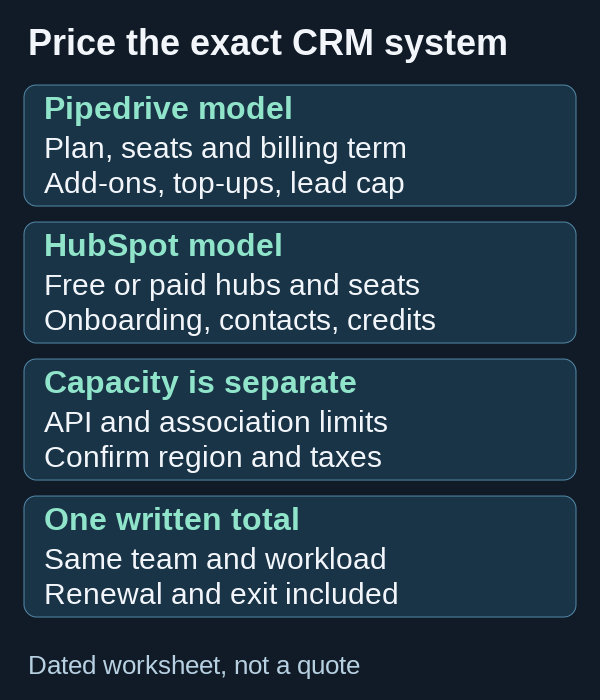
Normalize the same team, product boundary and capacity
Pipedrive pricing currently uses Lite, Growth, Premium and Ultimate. This research surface localized to AUD, so we are not presenting the supplied US annual signal as a reproduced checkout or converting it into a universal price. The 3 September billing guide distinguishes monthly payment from annual prepayment; paid seats include unassigned seats. LeadBooster, Projects and Smart Docs are extra on Lite/Growth and included on Premium/Ultimate; Campaigns and Web Visitors remain add-ons. Eligible top-ups follow the plan cycle and have quantity and plan limits. Account-settings access owns billing.
HubSpot's sales purchase page displays new-customer discount language. Its legal catalog separately lists Sales Hub Starter from USD20/month per Core Seat, Professional from USD100/month per Sales Seat and Enterprise from USD150/month per Sales Seat billed annually. Required onboarding is listed at USD1,500 for Professional and USD3,500 for Enterprise. These dated catalog/list checkpoints are not the promotional checkout or a quote for every region. Smart CRM, Sales Hub and other hubs are not interchangeable subscriptions.
| Buyer input | Pipedrive | HubSpot |
|---|---|---|
| People and term | Plan, billing country/currency/tax, purchased versus assigned seats, monthly or annual prepay, renewal and unused capacity. | Free versus paid product, edition, Core versus Sales Seats, view-only users, billing term versus commitment, region/tax, promotion expiry and renewal. |
| Configured capabilities | Email sync, automations, sequences, fields, reports, permissions, add-ons, API tokens and eligible top-ups. | Required hubs, onboarding, marketing-contact band, calling, credits, capacity packs, workflows, permissions, API and associations. |
| Usage and administration | Peak active leads and non-archived deals, imports, concurrent automation traffic, connected apps, telephony and duplicate cleanup. | Core record capacity is not the same as billable marketing contacts. Included credits and extra packs/pay-as-you-go require a rate and approval owner; do not add included allotments across products. |
| Whole-system cost | Implementation, training, administrator time, integration monitoring, support/SLA, files/storage, corrections, cancellation/refund, export and restore effort. Price the same 1/3/10-person fictional team and workload. This is a buyer worksheet, not observed spend, savings or a universal lowest-cost result. | |
The current HubSpot sales page distinguishes Starter Core Seats from Professional/Enterprise Sales Seats and offers view-only access. It lists 500/3,000/5,000 included monthly credits for Starter/Professional/Enterprise; included allotments are not additive across products and unused credits do not roll over. Confirm the exact rate sheet, paid actions and account purchase terms. Enter the resulting written offer into the total-cost calculator.
Plan record capacity, import errors and duplicate ownership
The 12 October Pipedrive usage guide gives new-plan leads/deals per seat at 2,500/5,000/15,000/20,000 for Lite/Growth/Premium/Ultimate, capped at 300,000 company-wide. It counts active leads plus non-archived open, won and lost deals. Manual creation is blocked at the limit; excess automated/API/import deals can reach a waitlist or skip file. Waitlisted deals are deleted after a year; automatically created leads have no waitlist and are discarded. Contacts have no Pipedrive usage cap, though a connected provider can impose one. This is vendor documentation, not record loss observed by ServiceTech.
The same guide separately gates fields, reports, active automations, if/else conditions, sequences, email sync, teams, permissions and API tokens. Archiving, buying an eligible top-up and changing tier solve different problems. Assign a named capacity owner before connecting forms or bulk imports.
HubSpot's technical catalog lists Free/Starter daily API calls 250,000, Professional 650,000 and Enterprise 1,000,000, with rate and add-on conditions. Association limits apply per record and association type, not as a shared pool. The catalog lists 1,000 contacts for free accounts and 15 million for paid accounts; this is not a marketing-contact billing allowance. Integrations may impose additional limits. Confirm the applicable API, record and association limits in the exact account rather than assuming the larger number guarantees throughput.
Pipedrive import uses object mapping and mandatory fields; its duplicate guide lets the importer recognize/merge or deliberately create separate records. HubSpot's import guide requires Import and object Edit permissions, and error reports separate skipped or incorrect data from accepted records. A retry is not permission to create the same enquiry twice.
HubSpot's 23 October duplicate-management guide requires Professional/Enterprise for individual duplicate management, with additional Data Hub gates for bulk handling and higher pair capacity. Data-quality and object-edit permissions also matter. Suggested matches are not proof of a safe merge or recoverable associations. Proposed buyer check: import matched and near-matched synthetic records, inspect merge decisions, Record IDs, associations and rejected rows with a restricted role and an administrator.
Separate automation limits, execution visibility and safe recovery
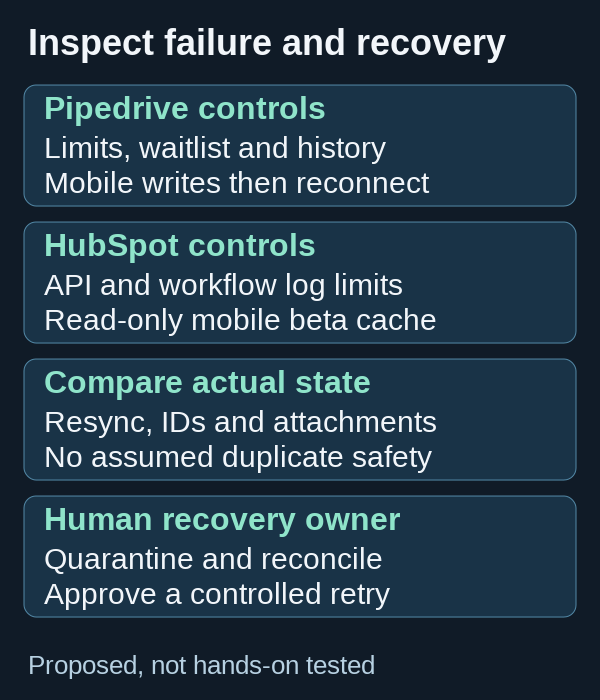
Pipedrive automation limits put Growth+ structure and frequency behind separate controls: up to ten actions, waits up to seven days, cumulative delays up to 90 days; 10,000 company executions or 5,000 for one automation within ten minutes; 40 automated email actions per minute company-wide. Bulk-edit overages can appear as Stopped, while loops/fan-out can be ignored without history entries. Provider email limits can fail actions too.
The automation overview exposes failures and no-execution cases, with company-wide visibility for global admins and own-automation visibility for regular users. History distinguishes success, failure, pending and stopped execution; unmet conditions can be discarded from the list. The history article still names an older plan family, so use the current Growth+ overview/limits for purchase eligibility. Neither a dashboard nor a successful run proves correct ordering or a duplicate-safe downstream write.
HubSpot's workflow details and FAQ document 90 days of action logs and six months of enrollment history. A 100,000 successful-execution log limit applies daily: after it is exceeded, success/info logs stop being stored for the rest of the day, while errors continue and records can keep enrolling/executing. This is a visibility boundary, not a 100,000-execution stop or a restorable audit archive. AI-related triggers/actions can separately consume credits and require feature permissions.
Proposed recovery control: name the system of record, use a stable enquiry ID and compare expected versus accepted records. Inspect permissions, API/rate response, logs and final downstream state before retrying. Keep customer contact behind approval, quarantine ambiguous records and provide a human fallback. No live API, stress, vendor-account or customer-contact test was performed.
Offline writes and a read-only beta solve different tasks
| Boundary | Pipedrive | HubSpot |
|---|---|---|
| Offline surface | Browser use is online-only; iOS/Android apps allow offline changes that update the database after reconnect. | 6 October mobile documentation describes an opt-in read-only beta: 50 recently viewed contacts, companies, deals and tickets each, up to 200 records total. |
| Available detail | Validate the intended app/OS, record/action and attachment handling. Sync language does not prove complete offline behavior, ordering or conflict safety. | Three recent engagements and five upcoming tasks per cached record. No offline create/edit/delete, file properties, attachments or custom objects. |
| Setup and recovery | Use two authorized roles for one controlled online/offline edit conflict; reconnect and inspect surviving values, duplicates and shared visibility. | Enable while online and reconnect to resync. Beta opt-in, object permissions and subscription eligibility apply; sensitive-data accounts are excluded. Confirm availability rather than assuming every free account has it. |
Neither boundary proves field reliability or an automatic winner. A sales rep who only needs cached reading has a different requirement from someone who must capture an estimate change without coverage. Rehearse loss of signal, resync, stale data, attachment access and the manual follow-up owner on each actual device.
Export components, then decide cancellation and retrieval cutoffs
| Component | Pipedrive | HubSpot |
|---|---|---|
| Records and activities | Export permissions and visibility constrain output. Global-admin item-type exports differ from lists, detail views and reports. Reconcile leads, deals, contacts, activities, notes, projects and file records separately. | Record exports contain current property values and associations, with Export permission. Contact activities may require individual exports, reports or the engagements API; filtered views are not an entire account. |
| Files and context | Record file handling is separate from record fields. Google Drive files are not included in global export. Validate actual file bytes, notes, email bodies/attachments and links. | Files and record/activity attachments have their own surfaces and permissions. A properties spreadsheet is not all associated files or email/history. |
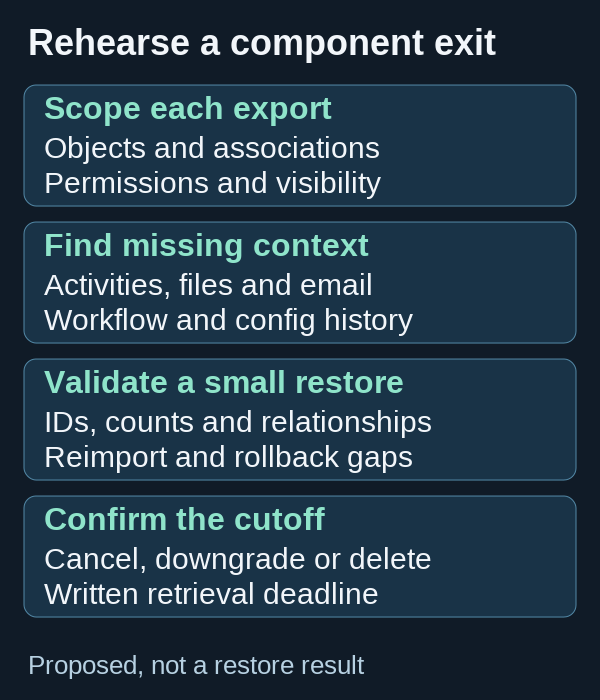
| Workflow and configuration | Inventory pipelines, stages, ownership, permissions, automations/workflows, webhooks, integrations, audit history and unsupported components. HubSpot's full export guide explicitly says all account data cannot simply be merged into another account: export/import named objects and recreate some assets. Validate a synthetic reimport and rollback; neither vendor has proved a complete restorable archive here. | |
Pipedrive's backup guidance schedules a closed paid account for deletion within 180 days; server backups are not a buyer-tested restoration. Cancellation ends access after the paid billing cycle; reactivation needs billing permission and data still existing. Deletion is irreversible once completed. Export before relying on any later retrieval.
HubSpot cancellation takes effect at commitment end, then downgrades to free tools; deletion is separate. Renewal terms and billing/object permissions need named owners. Review the free-tier effect on forms, workflows and connected assets before turning off renewal. HubSpot's record restoration guide has object, permission and time limits and excludes permanent/GDPR deletions. A record recycle bin is not account retention or an exit archive. Obtain written cancellation, deletion, retention and retrieval dates for the exact account before moving operational data.
One same-scenario protocol before keep, switch or no-buy
Proposed buyer checks, not completed tests: use authorized roles and synthetic records only. Do not send real customer data or contact customers while evaluating.
- Write one enquiry, estimate, follow-up, won/lost and field-system handoff, with a stable external ID and a named owner. Normalize 1/3/10 people, exact features, peak volumes and contractual term.
- Import one matched and one near-matched contact/company/deal set. Inspect IDs, associations, property mapping, permissions, duplicate decisions, skip/error files and rollback before retrying.
- Run a normal automation plus a controlled failure and safe retry. Compare intended enrollment/actions with run history, missing/stopped/failed entries, quota counters and the accepted downstream record. Check credit and customer-contact approval owners.
- On intended iOS/Android devices, compare Pipedrive's offline write/reconnect with HubSpot's eligible read-only beta. Test cache setup, stale data, attachments, resync and shared visibility; rehearse a conflict only where writing is supported.
- Export each required component with admin and restricted roles, filtered and full views. Check file bytes, email/history, associations and workflow/configuration gaps. Reimport a synthetic sample and confirm rollback and written retrieval deadlines before cancelling.
Keep the current system if it passes the required workflow and cost controls. Switch only when a matched buyer-run scenario addresses the named bottleneck and the handoff/exit inventory passes. Do not buy yet when seat/hub costs, offline eligibility, duplicate ownership, missing execution evidence or restore gaps remain unresolved.
Use the Pipedrive review, distinct Pipedrive versus monday CRM comparison and CRM shortlist without treating them as matched tests. The pilot guide, pilot scorecard, migration checklist, methodology and evidence ledger keep evaluation scope explicit.
A Quick Demo of Pipedrive CRM 🏁 🏎️
YouTube connects only after you choose to load this video.
Evaluation options: Each link is identified as an official or partner path. A marked partner link may earn ServiceTech Signal a commission. Commercial relationships cannot change the evidence, caveats, or decision criteria.
The decision in one table
| Decision factor | Pipedrive | HubSpot | How to decide |
|---|---|---|---|
| Primary operating model | Focused sales CRM organized around leads, deals, activities, contacts, and visual pipelines | Smart CRM foundation connected to marketing, sales, service, content, data, and revenue products | Choose the smallest system boundary the team can keep accurate |
| Current buying boundary | Lite, Growth, Premium or Ultimate; region, paid seats, term, add-ons and top-ups determine the total | Free tools for up to two users and 1,000 contacts; paid Smart CRM/Sales Hub are separate buying surfaces with seat, hub, onboarding, contact and credit controls | The 3 November Pipedrive surface localized to AUD. Separate HubSpot promotional checkout from legal catalog/list terms; do not reuse an August headline as a universal price. |
| Follow-up automation | Growth adds full email sync, tracking, automations, sequences, forecasting, and meeting scheduling | Starter can trigger tasks and email notifications on deal-stage changes; fully customizable workflows are a Professional or Enterprise boundary | Reproduce the real estimate follow-up before selecting the plan |
| Cost expansion | Per-seat plans plus LeadBooster, Projects, Campaigns, Web Visitors, Smart Docs, and usage top-ups | Seats, hubs, onboarding, marketing contacts, credits, calling, and advanced data controls can expand the total | Price the configured system rather than the headline tier |
| Data quality and exit | Major record exports are available, while activities, notes, files, and connected content need separate treatment | Record exports are available; automatic deduplication has baseline rules while the advanced duplicate manager is subscription-gated | Test imports, retries, merges, associations, activities, files, and a complete exit pack |
| Field service boundary | Does not replace dispatch, route operations, technician status, job costing, invoicing, or payment reconciliation | A wider customer platform still does not become a complete field service operating system | Declare the CRM-to-job-system contract before connecting production data |
Commercial disclosure: A marked partner link may earn ServiceTech Signal a commission. Official vendor links without an affiliate relationship are identified separately. Commercial relationships cannot change our evidence, caveats, or decision criteria.
The lighter path fits the actual operation.
- The urgent problem is ownership between enquiry, estimate, follow-up, won, and lost stages.
- The sales team benefits from an activity-first interface and an opinionated deal pipeline.
- The expected seat count, plan, add-ons, and usage top-ups fit the three-year model.
- A separate field or job system already owns dispatch, work completion, invoices, and payments.
The additional capability has a current owner and return.
- Two users can validate the free CRM before the business commits to a paid configuration.
- Marketing, sales, and service data genuinely need to converge on one governed customer record.
- The team has priced the required seats, hubs, onboarding, contacts, credits, and workflow tier.
- An administrator can own properties, pipelines, permissions, associations, automation, and duplicate policy.
Evidence still unresolved
- Same-account completion time for enquiry, estimate, follow-up, won, and lost scenarios
- Duplicate and association recovery after imports, forms, email sync, and integration retries
- Mobile behavior on the actual office and field devices, including low-connectivity work
- Complete export coverage for records, associations, activities, files, workflows, and configuration
- First-year and third-year cost for the same team, automation volume, and connected systems
Continue the research
- Browse every comparison path
- Read the Pipedrive review
- Compare Pipedrive and monday CRM
- Best CRM for local service businesses
- Field service software buyer's map
Primary sources
- Pipedrive pricing, plan family, and trial, with localized currency ↗
- Pipedrive billing, included versus paid add-ons, seats, and top-ups, updated 3 Sep 2026 ↗
- Pipedrive CRM functions and integrations ↗
- Pipedrive spreadsheet import, history, skip files, and 48-hour reversal ↗
- Pipedrive import duplicate matching rules ↗
- Pipedrive deals and linked activity record ↗
- Pipedrive activities and record linking ↗
- Pipedrive automation limits and execution history ↗
- Pipedrive automation overview, health monitoring, and deactivation controls ↗
- Pipedrive automation history visibility, discarded runs, and retention, updated 3 Sep 2026 ↗
- Pipedrive mobile offline behavior ↗
- Pipedrive data export coverage ↗
- HubSpot free CRM product and account limits ↗
- HubSpot Sales Hub pricing, seats, automation, and onboarding ↗
- HubSpot CRM record export coverage ↗
- HubSpot record deduplication controls ↗
Editorial record
Who reviewed this page and what happens next.
Commercial relationships cannot change the evidence state, fit statement, caveats, or conclusion.
- Research and review
- Andre Ribeiro
- Published
- Last material review
- Next scheduled review
- Evidence scope
- Worldwide readership with market specific product evidence
- Evidence state
- This comparison uses current official product, pricing, support, and data-management records. ServiceTech Signal has an active Pipedrive affiliate relationship and no current HubSpot affiliate relationship. Neither product has completed the same ServiceTech Signal direct account scenario, so the decision remains conditional and no numerical winner is assigned.
Testing methodologyEditorial standardsCorrections and update log
A marked partner link may earn ServiceTech Signal a commission. Partner and official paths stay visibly separated so the commercial relationship cannot replace the test result.